

Crypto Consumer Social Isn't Dead, It's Just Waiting to Be Built
Following all the Farcaster news there have been a lot of statements around web3 and consumer social being dead. This seems incredibly far-fetched and short-sighted when it comes to innovation and understanding that building startups and generational products is extremely difficult.
I first learned about the term skeuomorphism from Chris Dixon in his article, Tokens: A new digital primitive. In that article, he frames crypto’s early phase as being in a “skeuomorphic era,” meaning that many initial applications of blockchain (such as NFTs for art or offline ticketing) are analogies borrowed from existing domains rather than truly native innovations.
For those who haven’t come across it, Farcaster is a decentralised social media protocol built on Ethereum that enables users to create profiles, post and interact across a network of interoperable apps without relying on a single central server. It gives users control over their data, identity and social graph, and allows multiple clients and applications to plug into the same shared social layer, making censorship resistance, portability and privacy core features.
It’s obvious that Farcaster itself was quite a skeuomorphic product with its X-style feed, and the standard crypto additions to the platform such as a wallet and everything that gives access to wasn’t different enough. So apart from being an interesting experiment in decentralised social, it was inherently still skeuomorphic, which meant people didn’t really feel much need or incentive to migrate to it. I say this as a relatively early adopter of Farcaster (FID 2675).
The idea and belief in decentralised social is clearly not enough, the product has to be differentiated, useful and/or fun to use. What Farcaster clearly did well was attracting an interesting early userbase that was crypto native. This led to great conversations and experiments within Farcaster and contributed to the journey of many founders, building cool companies like Opacity:
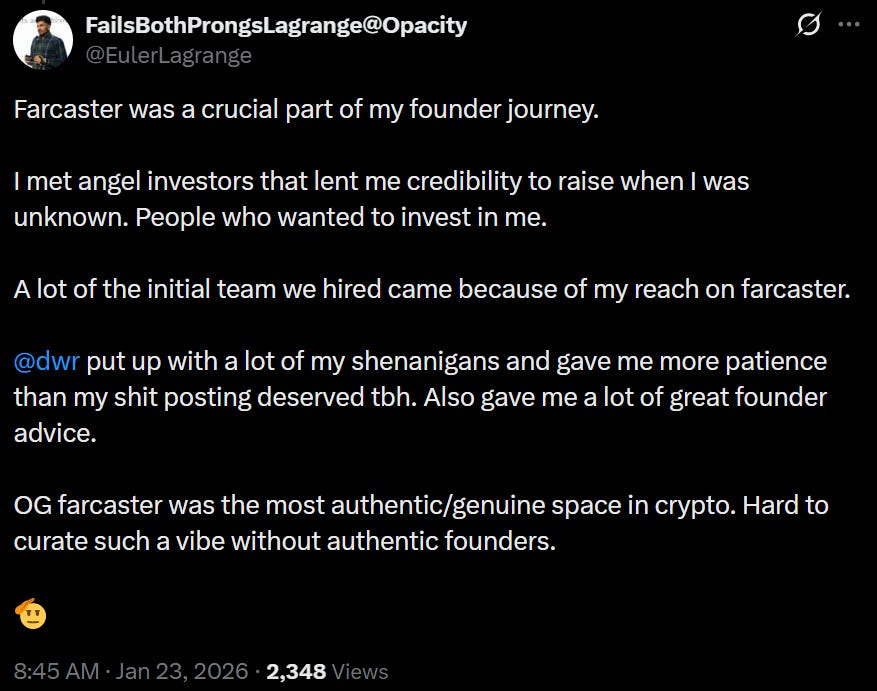
Operating within an echo chamber is not conducive to building great apps, so learning from more recent web2 social companies that were initially touted to be the next 100 billion dollar business, like Clubhouse, is also important. The design space for “native era” consumer apps is still wide open with lots of lessons to be learned from the likes of Farcaster, Lens, BitClout and others.
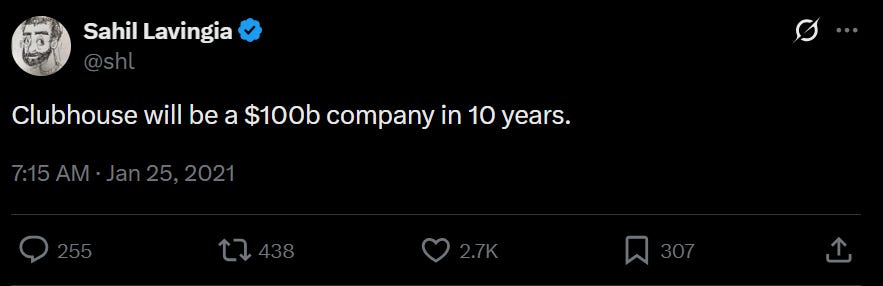
What seems clear as a venture investor is that investing in consumer social apps off the back of a quickly growing userbase, without clear data on retention and cohort analysis, is extremely difficult. Investors in the later rounds of Farcaster and Clubhouse seemingly would have faced this issue. At this point in time I don’t think consumer social companies need to raise huge rounds and hire massive teams, a great app that is not skeumorphic might be able to be built with a small team that is bootstrapped or has raised a couple of small rounds.
I am excited for this next phase of founders building consumer applications, with one of the main reasons being that the infrastructure is finally readily available. Since the beginning of crypto venture capital in 2013, billions of dollars have been invested in crypto infrastructure. A few years ago if I spoke to a consumer founder, they would have eventually pivoted to building infrastructure because the infrastructure they needed for their consumer application wasn’t available. That is no longer the case. Founders who want to build consumer apps can now focus on doing just that and plug and play any infra they need.
If you are building an interesting consumer app in crypto that is not just another take on prediction markets, get in touch!